
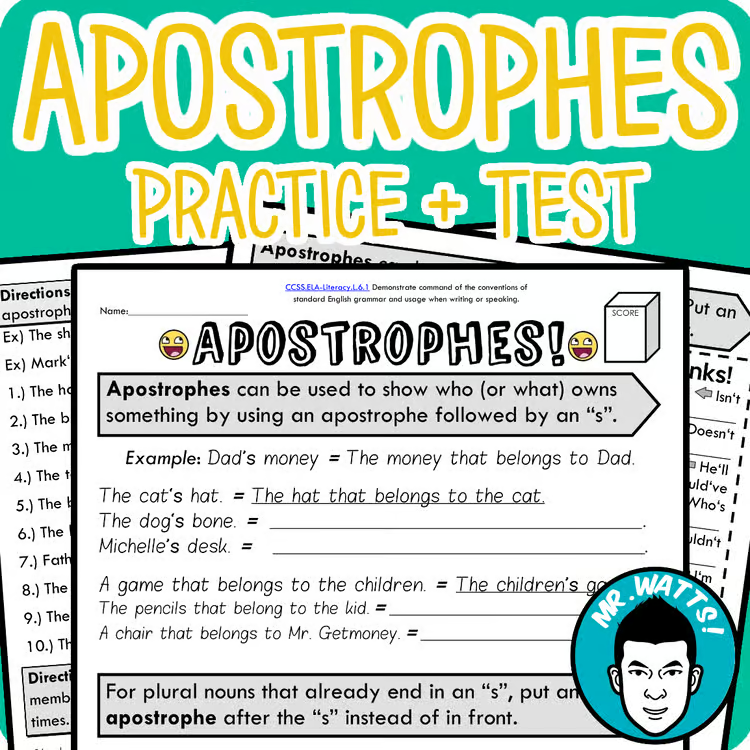
Ever feel like a tiny floating comma is out to get you? The apostrophe might be the smallest punctuation mark in the English language, but it carries a lot of weight. Whether you are showing who owns what or smashing two words together to save time, getting the apostrophe right is the hallmark of a polished writer.
Mastering these marks is a core part of the CCSS.ELA-Literacy.L.6.1 standard, helping students demonstrate a true command of English conventions. Let’s look at how to use the “punctuation glue” correctly every time.
1. Possession: Who Owns It?
The most common use for an apostrophe is to show ownership. However, the placement of that mark depends entirely on how many owners there are.
Singular Owners (The ‘s Rule)
If one person or thing owns something, you simply add an apostrophe and an “s.”
- The cat’s hat: One cat owns one hat.
- Michelle’s desk: The desk belonging to Michelle.
- The car’s battery: The battery inside one specific car.
Plural Owners (The s’ Rule)
When you have a group of owners that already ends in “s,” you don’t need another “s.” Just let the apostrophe hang out at the very end.
- The tigers’ toy: Many tigers share one toy.
- The neighbors’ road: A road used by many neighbors.
- The soldiers’ weapons: Equipment belonging to a group of soldiers.
The Exception: Irregular Plurals
Some words are plural but don’t end in “s” (like children, people, or men). In these cases, treat them like singular words and add 's.
- The children’s game: Not “childrens’ game.”
2. Contractions: The Great Word Mashup
Apostrophes also act as “placeholders” for missing letters when we combine two words into one. This makes writing sound more natural and conversational.
Common mashups include:
- Could have → Could’ve (The apostrophe replaces the “ha”)
- Did not → Didn’t (The apostrophe replaces the “o”)
- She will → She’ll (The apostrophe replaces the “wi”)
- I am → I’m (The apostrophe replaces the “a”)
Pro-Tip: If you aren’t sure if you need an apostrophe, try “un-smashing” the word. If “did not” fits the sentence better than a possessive, you need a contraction!
Common Pitfalls: The “Apostrophe Audit”
Before you turn in your next essay, perform a quick “Apostrophe Audit” by looking for these three common mistakes:
- The “Its” Trap: Remember that its (possession) never has an apostrophe. It’s only has an apostrophe when it means “it is.”
- Plural vs. Possessive: Don’t use an apostrophe just because a word ends in “s.” For example, “I saw three dogs” (plural—no mark) vs. “The dog’s bone” (possession—needs a mark).
- The Missing “O”: In words like shouldn’t or wouldn’t, the apostrophe always goes where the “o” in “not” used to be.
Refine Your Writing
Next time you’re proofreading, pay extra attention to those floating marks. Correct apostrophe usage doesn’t just make your grammar “right”—it makes your writing clearer and more professional. Whether you’re writing a diary entry about an otter at the zoo or a formal history report, these small strokes make a massive difference.


Leave a Reply