
I have spent many afternoons searching for the right balance between rigorous grammar instruction and genuine student interest. I realized early on that if I just handed out a list of definitions, my students would treat the lesson as a chore rather than a skill. This shift in my own mindset—from teaching a “subject” to facilitating an “experience”—is what led me to resources that feel more like a discovery and less like a lecture.
You likely know the feeling of looking out at a classroom where “Grammar” is met with a collective sigh. You want your students to demonstrate a command of standard English conventions, but you also want them to enjoy the process of learning.
A Structured Path to Noun Mastery
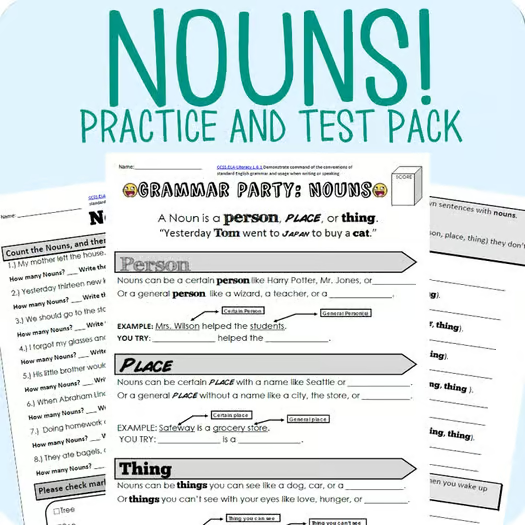
You can use this free, multi-page “Grammar Party” packet to guide your students through the foundational building blocks of language. This resource is specifically designed to meet CCSS.ELA-Literacy.L.6.1 standards while maintaining an approachable tone.
When you introduce nouns as more than just a “person, place, or thing”, you open up a world of categorization for your students. You can lead them through these specific distinctions:+3
- Proper vs. Common: You can help students distinguish between special, one-of-a-kind nouns like “Harry Potter” or “Nintendo” and regular, common nouns like “wizard” or “video-game”.
- Concrete vs. Abstract: You can challenge your students to identify what they can physically experience—like “Pizza” or “Snow” —versus ideas they can’t touch, such as “Love,” “Sadness,” or “Surprise”.
Engaging Practice and Application
You will find that this packet moves quickly from theory to action. Your students won’t just memorize definitions; they will actively hunt for nouns within sentences. They will analyze examples like “My dog spilled food in the kitchen” or “Seattle is the largest city in Washington” to determine if a noun represents a person, place, or thing.
The application goes even deeper as you ask your students to:
- Construct Sentences: They follow specific directions to write their own sentences with varying counts of nouns, such as a sentence containing exactly one person, one place, and one thing .+1
- Personalize the Learning: You can have them write a paragraph about their own morning routines, circling every noun they use to describe their day.
The Power of Randomness in Grammar
While the worksheet is structured, you can keep the energy high by introducing an element of randomness. I have found that “leaving it to chance” removes the pressure of being perfect and turns a grammar review into a game.
You might try these “Randomness” strategies with the provided text:
- The Noun Roll: Have your students roll a die. If they roll a 1, they must find a proper noun on page 2. If they roll a 2, they must find an abstract noun.
- Random Sentence Swap: After students write their “morning routine” paragraphs, you can have them randomly swap papers with a partner to see if they can identify the nouns their peer used.+1
- The Box Challenge: On the final test page, there is a list of words where students mark the box next to each noun. You can turn this into a timed “random selection” game to see how quickly they can distinguish “Tiger” (noun) from “Pretty” (adjective) or “Eat” (verb).+4
Assessing Student Growth
To wrap up the unit, the packet includes a comprehensive Nouns Test. This isn’t just a multiple-choice quiz; it requires your students to find and copy nouns from specific sentences—like identifying “Mother” and “House” from sentence one or “Puppies” and “Airplane” from sentence nine .+4
By using this free resource, you are giving your students a clear, student-led path to understanding the architecture of their own language. When they realize that nouns are the characters and settings of their own lives, the “Grammar Party” truly begins.


Leave a Reply