
I remember sitting in a writing workshop years ago when I realized that many of my students viewed point of view as a mere technicality—a box to check rather than a powerful tool for storytelling. I saw them struggle to maintain a consistent voice, often slipping from the intimacy of the first person into an accidental third-person narrator mid-paragraph. It was a clear sign that they understood the “who” of the story but hadn’t yet mastered the “how” of the narration.
When you transition from teaching plot to teaching perspective, you are giving your students the keys to a character’s inner world. You aren’t just teaching them to identify a narrator; you are helping them understand how an author develops a specific point of view to shape the reader’s experience.
Decoding the Three Main Perspectives
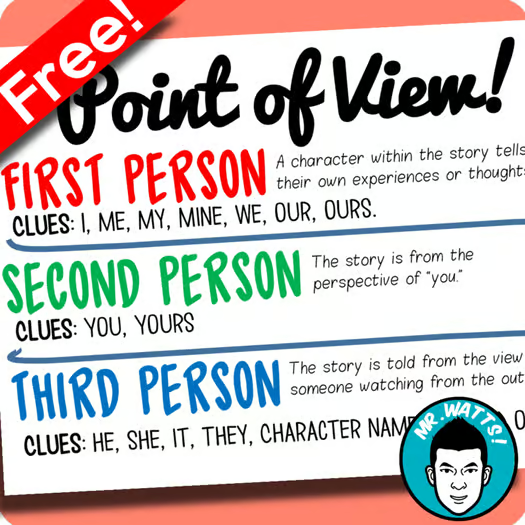
To help your students navigate these multiple methods of narration, you can provide them with a clear, visual reference. You can use this free “Point of View Cheat Sheet” to help them remember the specific clues that signal each style:
- First Person: This is when a character within the story tells their own experiences or thoughts. You can teach your students to look for the “inside” clues: I, ME, MY, MINE, WE, OUR, and OURS.
- Second Person: Here, the story is told directly from the perspective of “you”. The primary clues for this style are YOU and YOURS.
- Third Person: This perspective is told from the view of someone watching from the outside. You can show your students that this style relies on clues like HE, SHE, IT, THEY, or using character names instead of “I”.
Helping Your Students “Pick and Stick”
In your writing units, you can use this cheat sheet as a handy guide to help students not only pick a narrative style but also stick to it. Consistency is often the biggest hurdle for young writers. By having these clear word-choice examples at their desks, they can self-check their work: “Am I using ‘I’ when I should be using ‘He’?”
This tool is especially effective when you are looking to nail the Common Core standard (CCSS.ELA-Literacy.RL.6.6) which requires students to explain how an author develops the point of view of the narrator or speaker in a text. By starting with the basic pronouns and definitions, you provide the foundation your students need to analyze more complex techniques like unreliable narrators or shifting perspectives.
Why This Tool Belongs in Your Writing Folders
If you are looking for a simple, effective way to help your students remember these methods, this one-page resource is a perfect fit. It removes the guesswork and allows your students to focus on the creative side of their stories.
- You spend less time correcting pronoun slips and more time discussing character development.
- Your students feel more confident in their ability to manipulate narrative voice to achieve a specific effect.
- You create a classroom culture where the “architecture” of a story is just as celebrated as the plot.
Whether you are in the middle of a rigorous narrative writing unit or just beginning a new novel study, you can use this cheat sheet to ensure your students always know exactly who is talking—and why it matters.


Leave a Reply